
The Governance & Compliance
Control Plane for Regulated
AI Agents
OpenEAGO is an open specification that adds jurisdiction-aware policy enforcement, mandatory HITL gates, composite risk scoring, and audit anchoring on top of A2A and MCP — the compliance layer those protocols explicitly don't own.
Step 1 — Contract Management
Parse and validate the business request, apply security checks, detect task types, and enrich with OASF schema using the Generator → Evaluator → Optimizer pattern.
Step 2 — Planning & Negotiation
Capability discovery, SLA/SLO feasibility checks (latency · availability · throughput · error_rate), KYC/AML, cross-border data clearance.
Step 3 — Validation & Compliance
Composite risk score across four dimensions (financial · operational · compliance · security) with hard-stop thresholds and mandatory HITL gates for high-risk workflows.
Step 4 — Execution & Resilience
Sequential/parallel/mixed task routing with circuit breakers, SLA breach state machine (8 states), and compensating transactions.
Step 5 — Context & State Management
Four-tier context hierarchy (session → conversation → agent → task) with CRDT-based concurrent state merging and lineage provenance at every transition.
Step 6 — Communication & Delivery
Auth levels 1–4, jurisdiction-aware routing, and blockchain-anchored audit records for regulator review.
Delegates wire mechanics to — rides on top of



Features
The compliance machinery A2A and MCP don't provide
OpenEAGO is additive, not a parallel protocol stack. It rides on top of A2A transport and MCP tool invocation, adding the normative governance layer that regulated industries require — jurisdiction enforcement, risk scoring, HITL gates, and audit anchoring.
Jurisdiction-Aware Policy Enforcement
Real-time compliance checks against GDPR, DORA, EU AI Act, SR 11-7, BCBS 239, PCI-DSS, MiFID-II, and EMIR — applied before and during execution, not as an afterthought.
Composite Risk Scoring
Four-dimension risk model — financial, operational, compliance, security — computed at Phase 3. Risk tiers (low / medium / high / critical) gate execution with hard stops at the critical threshold.
Four-Level Agent Identity
X.509 workload certificates via SPIRE/SPIFFE, with four authentication tiers from API-key + RBAC baseline up to hardware-backed identity with dual-control HITL for the most sensitive operations.
Mandatory HITL Gates
Human-in-the-loop approval is a normative requirement for high-risk workflows (risk_tier ≥ high). The spec defines structured decision artifacts — approved / rejected / modified — with full audit records.
Cross-Border Data Clearance
Automated data residency validation and sovereignty enforcement at Phase 2 Planning. Jurisdiction-aware routing at Phase 6 Communication ensures data never traverses a prohibited border.
Distributed Agent Registry
Phase 2 capability discovery with mTLS-authenticated registration. Filter by capability type (kyc_verification, aml_screening, credit_risk_assessment…), compliance profile, jurisdiction, SLA tier, and reliability score.
SLA/SLO Enforcement & Breach State Machine
Quantitative feasibility checks at Phase 2 across four SLO dimensions. Phase 4 tracks SLA health through 8 canonical states — active, at_risk, breached, pause_and_review, fallback_activated, escalated, completed, terminated.
CRDT Context & Lineage Tracking
Four-tier context hierarchy (session → conversation → agent → task) with CRDT-based concurrent state merging, auditable merge history, and lineage provenance for every context transition.
Audit Anchoring & Provenance
ECDSA P-256 signed manifests for every AI agent invocation. Tamper-evident audit records across all six phases — structured for regulator review and blockchain-anchored via Phase 6 Communication & Delivery.
Architecture
Six normative phases for governed, regulated agent workflows
OpenEAGO defines a strict six-phase execution model. Each phase has normative requirements, canonical vocabularies, and conformance test cases — not guidelines.
-
1Contract Management
Parse and validate the business request, apply security checks and task detection, enrich with OASF schema. Generator → Evaluator → Optimizer pattern.
-
2Planning & Negotiation
Discover agents by capability, compliance profile, and data residency. Run SLA/SLO feasibility, KYC/AML checks, cross-border data clearance, and cost/risk budgets before committing.
-
3Validation & Compliance
Compute composite risk score (financial · operational · compliance · security). Enforce hard stops at critical tier. Require HITL decision artifact for high-risk workflows.
-
4Execution & Resilience
Route tasks via sequential, parallel, or mixed orchestration. Monitor SLA health through the 8-state breach state machine. Trigger circuit breakers and compensating transactions as needed.
-
5Context & State Management
Maintain four-tier context hierarchy (session → conversation → agent → task) with CRDT-based merging, lineage tracking, and audit anchoring at every transition.
-
6Communication & Delivery
Deliver messages via auth levels 1–4, jurisdiction-aware routing, compliance monitoring, and blockchain-anchored audit records for tamper-evident regulatory reporting.
base-envelope.schema.json
{
  "message_id": "msg-<uuid-v4>",
  "spec_version": "0.1.0",
  "phase": "planning_negotiation",
  "timestamp": "2026-06-09T10:00:00Z",
  "correlation_id": "contract-<uuid-v4>",
  "sender": {
    "agent_id": "aml-screening-agent-01",
    "identity": "spiffe://corp/aml-agent"
  },
  "payload": {
    "negotiation": {
      "checks": {
        "sla_slo": { "p99_ms": 800, "availability_pct": 99.5 },
        "kyc_aml": { "required": true },
        "cross_border": {
          "jurisdiction": "EU",
          "data_residency": "eu-west-1",
          "compliance": ["GDPR", "DORA"]
        }
      }
    }
  },
  "metadata": {
    "regulatory_profiles": ["financial_services_eu"],
    "risk_tier": "high",
    "hitl_required": true
  }
}
Live demo
Watch the six phases run — live
The reference implementation wires agent-template and agent-registry into a runnable six-phase pipeline with a real-time WebSocket dashboard. Composite risk scoring, the mandatory HITL gate, and the SLA breach state machine aren't just described on paper — click a scenario and watch them happen.
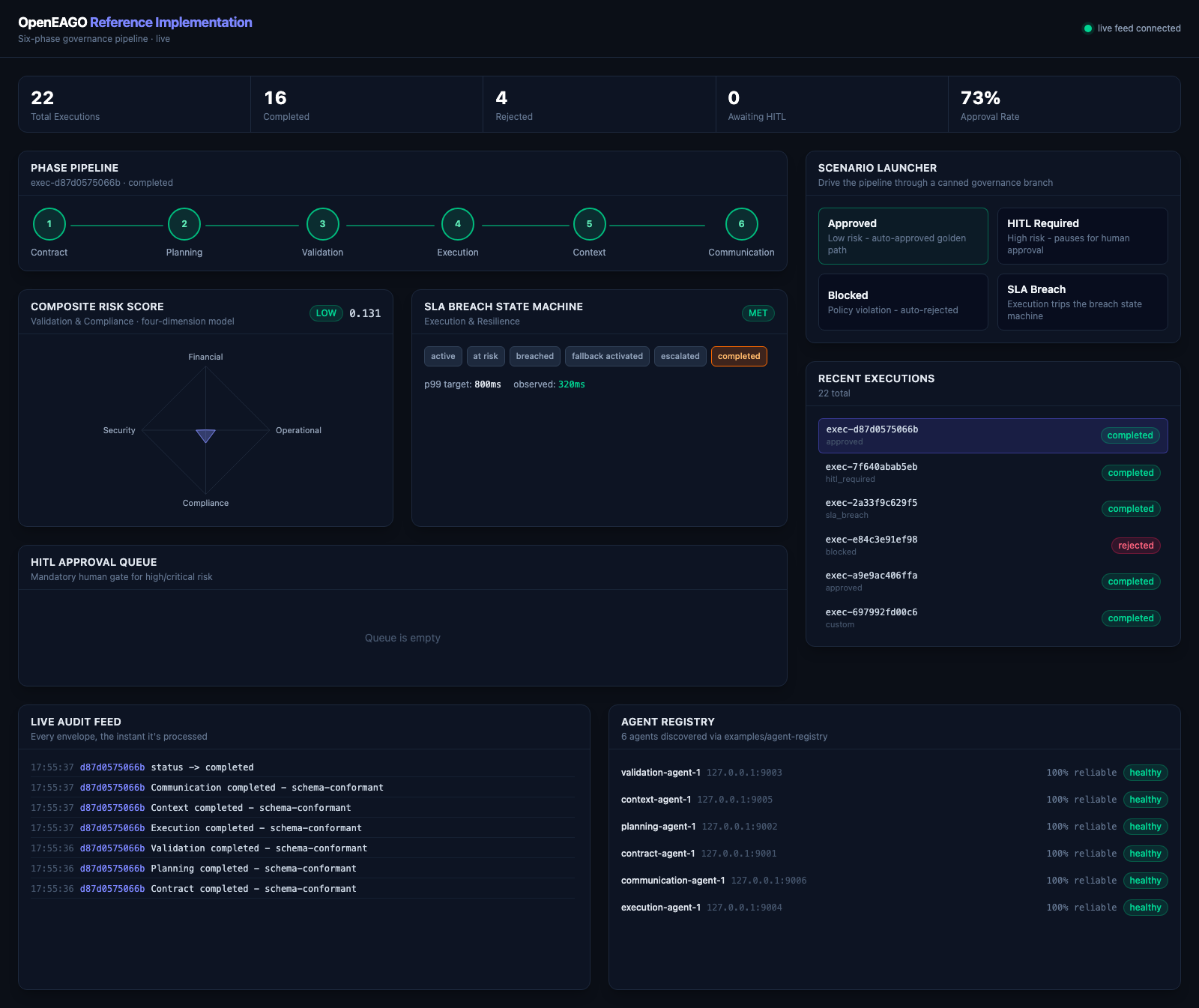
Low risk → auto-approved golden path
All six phases complete in real time. Composite risk score 0.131 (low tier), SLA target met, HITL auto-decided.
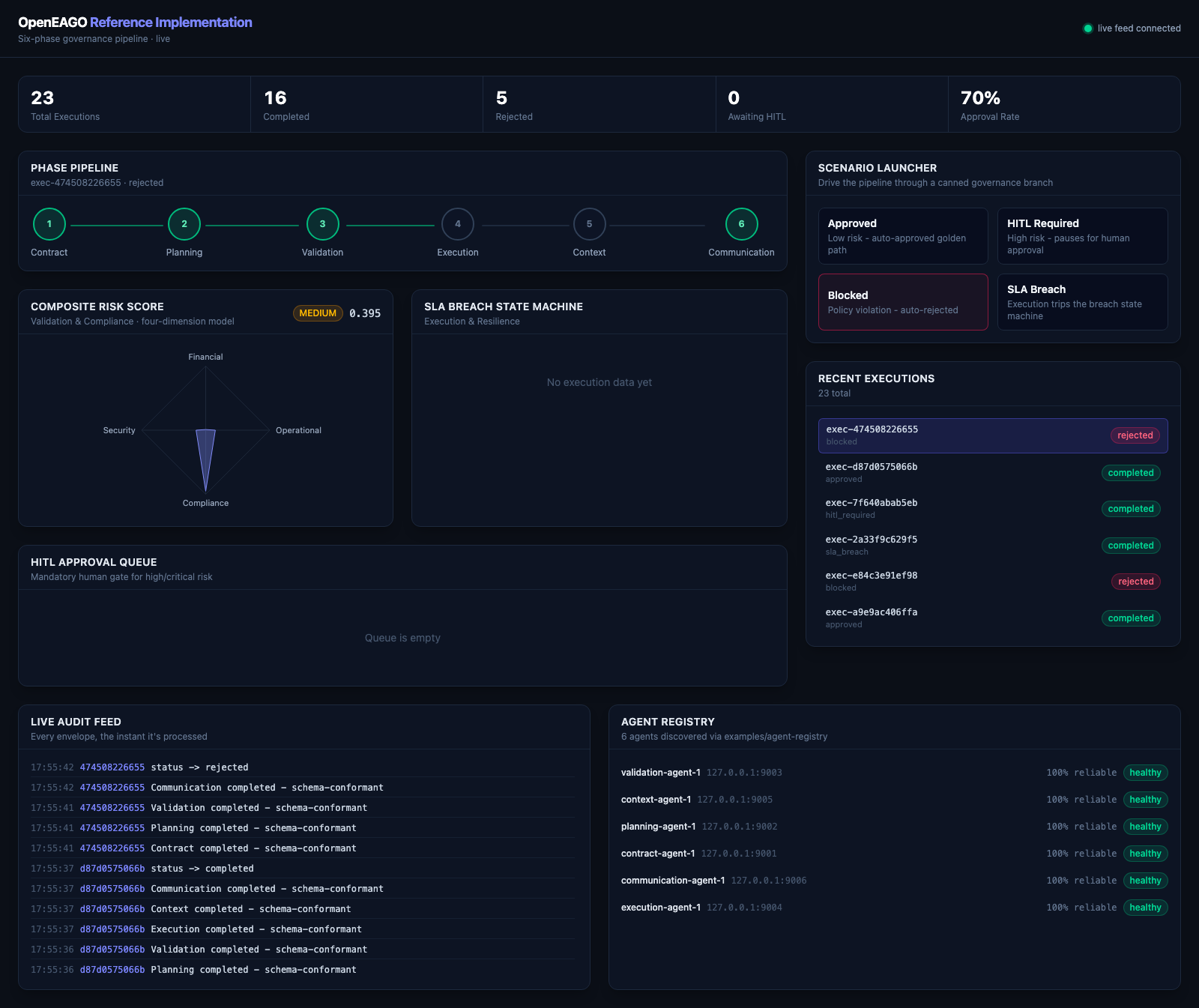
Policy violation → auto-rejected
Validation rejects the request and the pipeline short-circuits straight to Communication — Execution and Context are genuinely skipped, not just hidden.
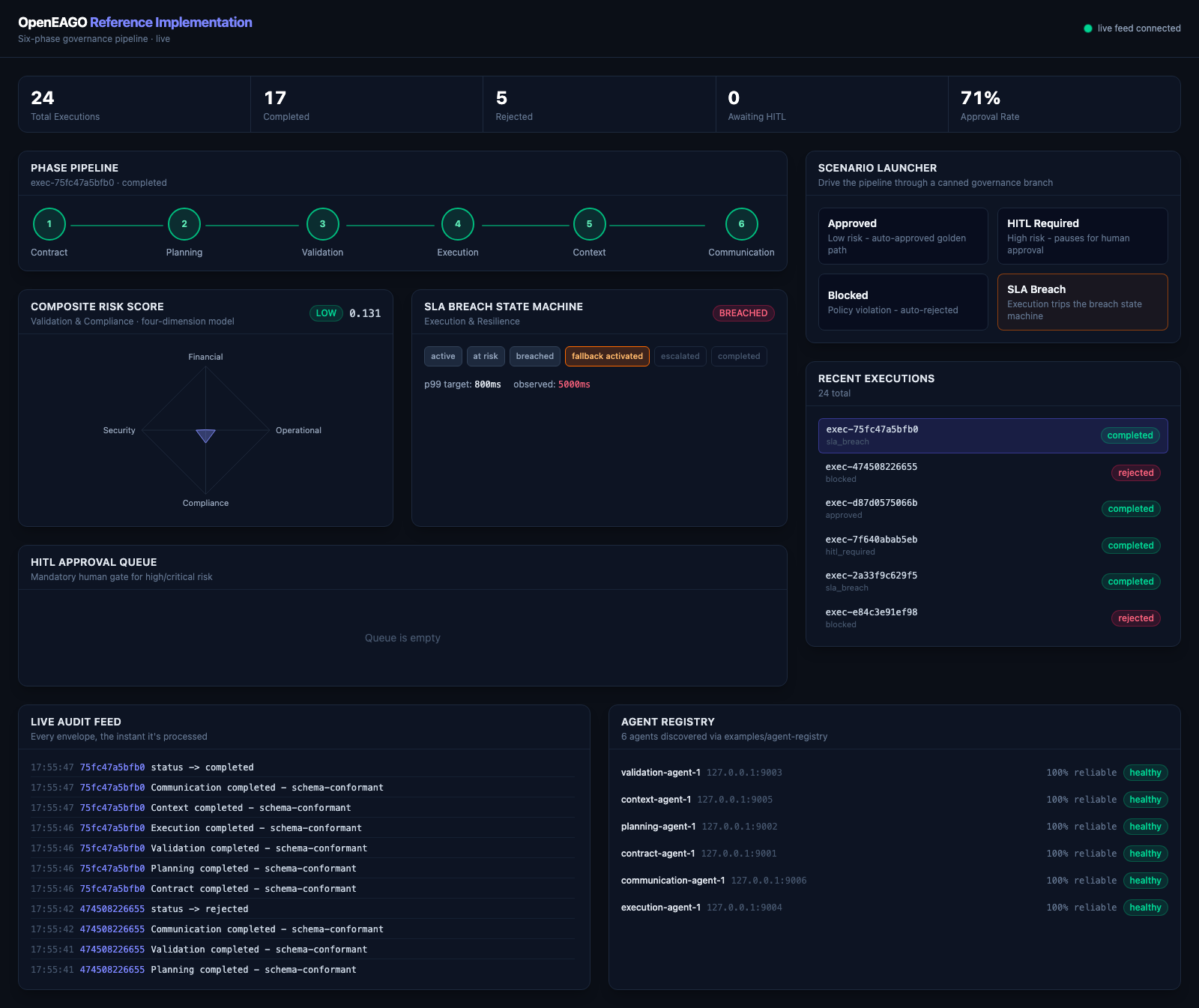
Latency breach trips the state machine
Execution completes, but observed p99 latency (5000ms) blows past the negotiated SLA (800ms) — the breach state machine lands on fallback_activated.
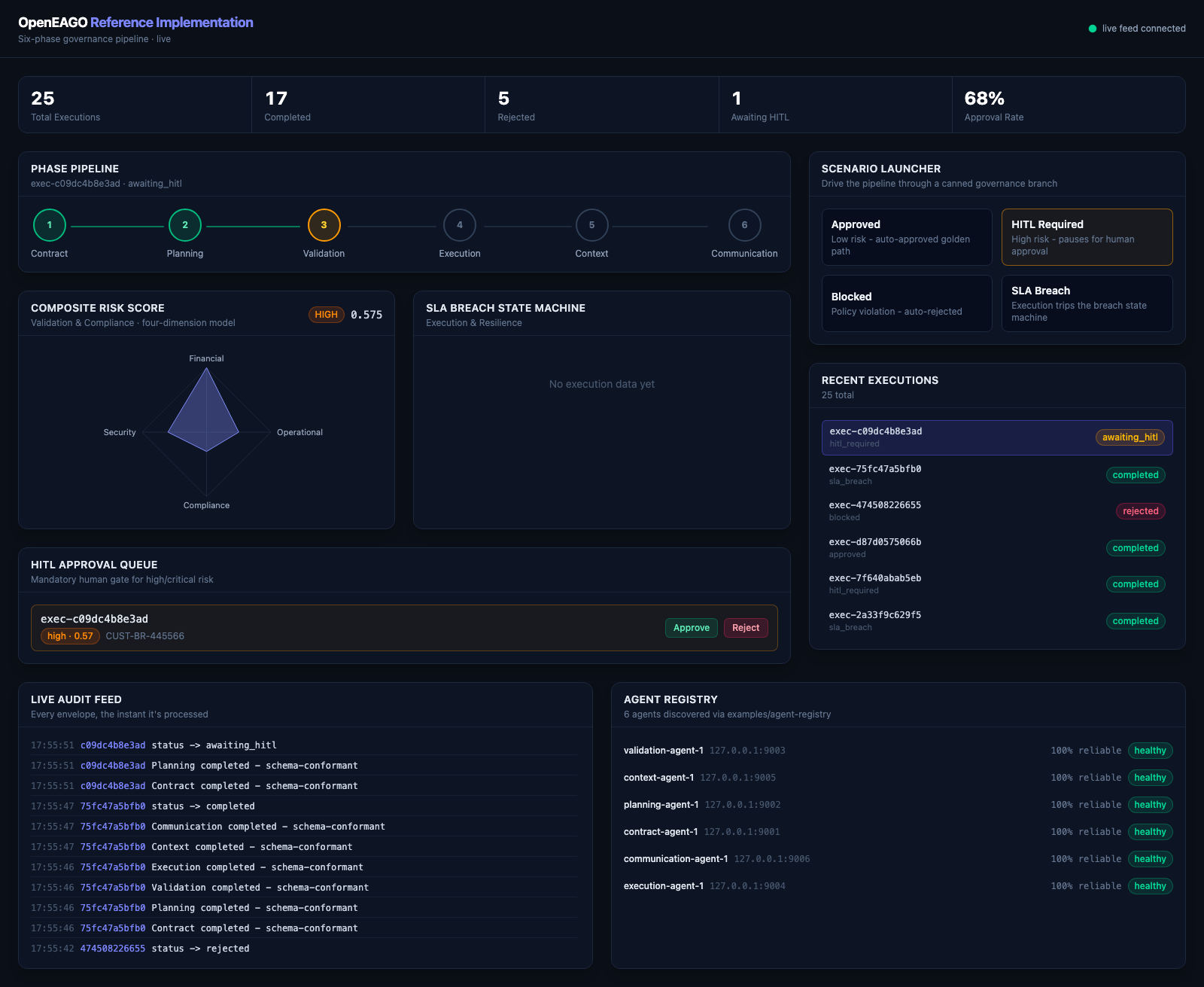
High risk → pauses for a human
Composite risk score 0.575 (high tier) pauses the pipeline at Validation. The item lands in the HITL Approval Queue for a real Approve/Reject decision before continuing.
Reference implementations
Conformance targets, not just examples
Each implementation targets one or more normative phases of the specification and ships with conformance test cases.
Reference Implementation (All Phases)
End-to-end demo wiring agent-template + agent-registry into a runnable six-phase pipeline with a real-time WebSocket dashboard. Composite risk scoring, the mandatory HITL gate, and the SLA breach state machine are all interactively observable. See screenshots ↑
View example →Agent Template
Reference MCP agent with full six-phase OpenEAGO alignment. Includes SPIRE mTLS, registry integration, and optional EAGO envelope mode. Configuration-driven via YAML — the canonical starting point for any compliant agent.
View example →Agent Registry (Phase 2)
Distributed agent discovery over mTLS with SPIRE/SVID. Agents register capabilities and are discovered via rich filters: capability type, compliance profile, jurisdiction, SLA tier, and reliability score ≥ 0.95.
View example →Context Management (Phase 5)
CRDT-backed concurrent state management for multi-agent workflows. Implements the four-tier hierarchy (session → conversation → agent → task) with auditable merge history and lineage provenance.
View example →Provenance Manifest (Phase 4/6)
ECDSA P-256 cryptographically signed audit records for every AI agent invocation. Produces tamper-evident manifests structured for regulator review — the audit anchoring primitive for Phase 6.
View example →Sui Agent Registry (R&D)
On-chain agent identity, reputation scoring, and discovery on the Sui blockchain (Move). Live on testnet. Three registries: Identity, Reputation, Validation — inspired by ERC-8004 and OpenEAGO identity concepts.
View example →MCP-ERC8004 Enterprise (R&D)
Nine-layer authorization stack combining ERC-721 on-chain identity, MCP agent invocation, and Solidity oracle contracts. Models a cross-institutional bank onboarding workflow spanning UK, Singapore, and USA jurisdictions.
View example →Use cases
Built for regulated, high-trust environments
OpenEAGO was designed around a concrete scenario: a bank onboarding workflow spanning UK → Singapore → USA, where every data transfer requires jurisdiction-specific clearance, every agent invocation requires a signed manifest, and any high-risk step requires a HITL approval gate.
Chain kyc_verification, aml_screening, credit_risk_assessment, and sanctions_screening agents with deterministic handoffs — each step gated by composite risk score and signed audit manifests.
Cross-border data clearance at Phase 2 enforces GDPR, FATCA, and MAS-mandated residency rules before any data leaves a jurisdiction. Phase 6 routes messages to compliant endpoints only.
HIPAA compliance profile enforces consent management and data residency across patient data agents. HITL gates are required for any diagnostic recommendation crossing a risk threshold.
Security scanners, CI/CD agents, and incident responders communicate via signed envelopes. Every policy change is anchored to an immutable audit record before it is applied.
Why teams adopt OpenEAGO
OpenEAGO is a profile and governance overlay. It delegates wire mechanics to A2A and tool invocation to MCP — adding only the compliance machinery those standards explicitly don't own.
The specification ships with JSON schemas, a canonical domain vocabulary, and conformance test cases. Compliant implementations can be validated — "works with OpenEAGO" means something concrete.
ECDSA-signed provenance manifests and blockchain-anchored Phase 6 records are structured for regulator review — not just internal logging.
Canonical compliance profiles for GDPR, DORA, EU AI Act, SR 11-7, BCBS 239, MiFID-II, EMIR, and PCI-DSS ship in the domain vocabulary — not bolted on.
X.509 workload certificates with ≤ 48 h TTL, four authentication tiers, and mTLS mutual authentication — consistent zero-trust identity from the wire up to the application layer.
Blog
Latest updates
Short updates on releases, roadmap milestones, documentation, and news.
Conformance test suite — validate your OpenEAGO implementation
A comprehensive conformance test suite covering communication delivery, context hierarchy, planning negotiation, HITL validation, and phase enumeration.
Jun 9, 2026Sui Agent Registry — on-chain agent identity, reputation, and discovery
A blockchain-based reference implementation on the Sui network providing immutable agent registration, capability indexing, reputation scoring, and real-time discovery.
May 13, 2026Agent discovery with capability filtering in the agent registry
The Rust agent registry now supports rich query filters — filter by capability, compliance tag, or reputation score to find the right agent for any regulated workflow.
Apr 19, 2026OpenEAGO 0.1.0 — Initial release with core specification
Initial release of OpenEAGO 0.1.0, featuring the core specification and documentation to get started.
Feb 14, 2026Q1 2026 goals: Initial 0.1.0 release and agent registry
Focus on core specification features, reference implementation, and community building.
Feb 10, 2026First commit to the OpenEAGO specification and reference implementation
Initial commit laying the foundation for future development and community contributions.
Jan 20, 2026FINOS Labs welcomes OpenEAGO as the newest project in the foundation
Join maintainers and contributors to shape the next-gen enterprise multi-agent standard.
Dec 16, 2025Community
Build the future together
Join the OpenEAGO community to shape the next generation of enterprise multi-agent standards.
Community checklist
- Review the OpenEAGO specification and share feedback.
- Join weekly design calls and RFC reviews.
- Ship reference implementations for your stack.
- Sign contributions with DCO and open pull requests.
- Report issues and propose new RFCs on GitHub.